
Stakeholder Centered
Lasting leadership change is measured not by what a leader intends to do, but by what others experience.
That simple idea is the foundation of Stakeholder Centered Coaching, the evidence-based executive coaching methodology developed by renowned executive coach Marshall Goldsmith. It’s unlike traditional coaching approaches that rely primarily on self-reflection and conversation.
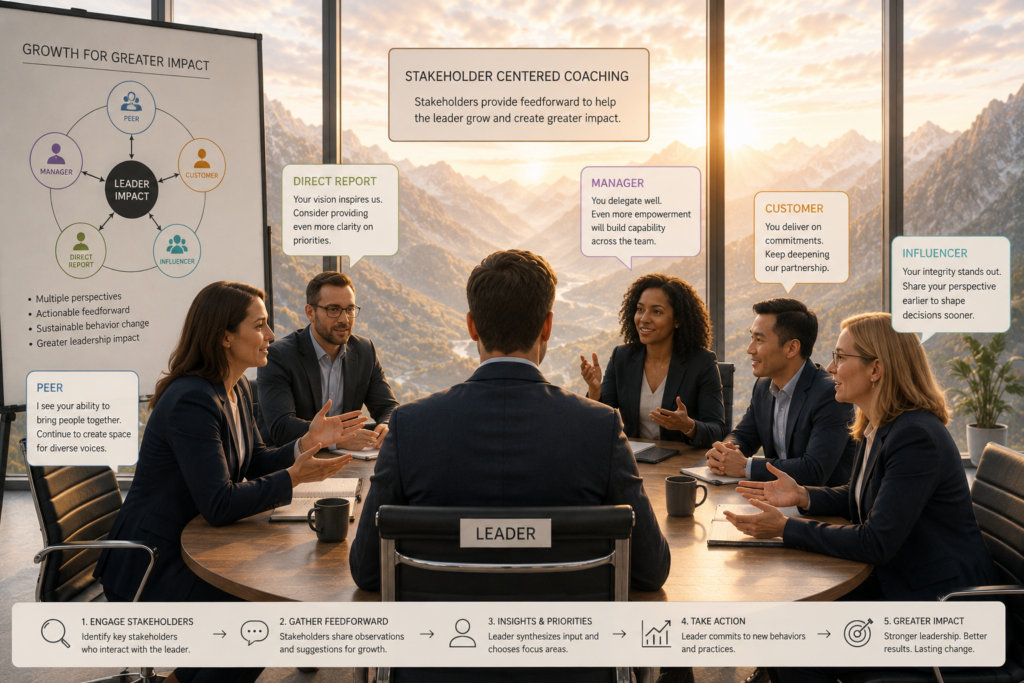
Stakeholder Centered Coaching actively engages the people who work with the leader every day, creating a powerful system of feedback, accountability, and measurable behavior change.
The process begins by identifying one or two leadership behaviors that will have the greatest positive impact on the leader’s effectiveness. Rather than attempting to improve everything at once, the coaching focuses on a small number of high-leverage behaviors that can produce meaningful and lasting results.
Once these development priorities have been identified, the leader invites a group of stakeholders, including managers, peers, direct reports, and others who interact with them regularly, to participate in the development process. These stakeholders are not asked to evaluate or criticize the leader. Instead, they become partners in the leader’s growth by providing ongoing feedforward: practical suggestions focused on future improvement rather than past mistakes.
This distinction is one of the defining characteristics of Stakeholder Centered Coaching. Feedback often encourages people to dwell on what went wrong. Feedforward shifts the conversation toward what can be done differently moving forward.
This future-focused approach reduces defensiveness, encourages collaboration, and creates greater optimism around change.
Throughout the coaching engagement, the leader regularly follows up with stakeholders to share progress, ask for additional suggestions, and demonstrate a genuine commitment to improvement. These brief, structured conversations build trust, increase transparency, and reinforce accountability. Equally important, they signal humility, a leadership quality that consistently strengthens credibility and influence.
The coaching process typically includes confidential stakeholder interviews or assessments, clearly defined development goals, regular one-on-one coaching sessions, action planning, and periodic follow-up with stakeholders. At the conclusion of the engagement, stakeholders are asked to evaluate the leader’s progress. Because improvement is measured by the people who experience the leader’s behavior every day, success is based on observable change rather than self-perception.
Stakeholder Centered Coaching is particularly effective for leaders who want to:
- Increase executive presence and leadership effectiveness
- Improve communication and interpersonal relationships
- Build trust and credibility across the organization
- Strengthen collaboration with peers and cross-functional partners
- Become a more effective coach and developer of others
- Navigate organizational change with greater confidence
- Enhance influence without relying on formal authority
- Address behaviors that may be limiting career growth
- Accelerate readiness for larger leadership responsibilities
The framework has been successfully used by senior executives and leadership teams around the world because it focuses on measurable outcomes rather than abstract leadership concepts. Research consistently shows that leaders who actively seek feedback, follow up with stakeholders, and demonstrate visible commitment to change are significantly more likely to improve than those who rely solely on personal insight or good intentions.
At its core, Stakeholder Centered Coaching recognizes that leadership is a relationship, not a position. The most meaningful measure of a leader’s effectiveness is how others experience their leadership. By combining executive coaching with stakeholder involvement, structured follow-up, and future-focused feedforward, this methodology creates sustainable behavioral change that benefits the individual leader, strengthens relationships, and improves organizational performance.
The result is leadership development that is practical, measurable, and enduring: one that transforms not only how leaders see themselves, but how they are experienced by the people they lead every day.